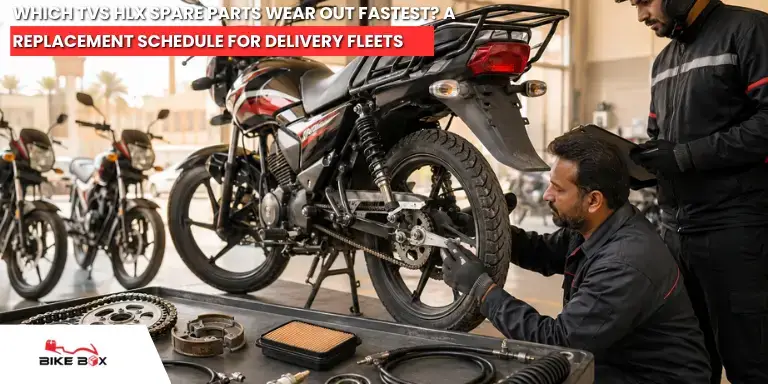
Delivery fleets depend on motorcycles that can handle long working hours, heavy loads, stop-and-go traffic and challenging road conditions. The TVS HLX series is widely used for commercial riding because it is designed for practical, everyday operation and efficient transportation.
However, even a durable motorcycle experiences wear when it is used continuously. A delivery bike can accumulate significantly more mileage than a privately used motorcycle, which means components such as brake shoes, tyres, chains, sprockets, clutch components, filters and control cables need closer attention than a manufacturer’s general service schedule assumes.
For fleet owners, the key is not simply replacing parts at a fixed kilometre interval. The better approach is to combine regular inspections, scheduled servicing, mileage tracking and condition-based replacement. This guide gives you that structure a mileage-based inspection schedule built specifically around how TVS HLX spare parts are actually used in delivery operations, not how they’re used by an average rider.
For fleets in the Gulf, Bikebox provides motorcycle spare parts to help businesses and individual riders maintain their motorcycles with dependable replacement components.
Why TVS HLX Bikes Experience Faster Spare Parts Wear in Delivery Operations
A motorcycle used for deliveries operates under different conditions from one used occasionally for personal transportation.
A delivery bike may spend many hours on the road every day, repeatedly accelerating, braking, changing gears, carrying loads and travelling over uneven surfaces. These conditions can accelerate wear on several components.
The main factors include:
- Frequent braking: Stop-and-go city traffic increases brake usage and can accelerate brake-shoe or brake-pad wear, depending on the braking system.
- High mileage: More kilometres mean more cycles of movement and friction for the drivetrain, tyres, cables and other moving components.
- Heavy loads: Carrying delivery equipment or additional weight places greater demands on tyres, suspension, brakes, clutch components and the drivetrain.
- Poor road surfaces: Potholes, uneven roads and debris can increase stress on tyres, wheels, suspension components and steering-related parts.
- Frequent clutch use: Heavy traffic can require repeated clutch engagement, particularly when riders constantly stop and start.
- Dust and heat: Gulf’s hot and dusty environment can increase the importance of checking filters, tyres, fluids, cables and rubber components regularly.
- Riding style: Harsh acceleration, hard braking, riding with an incorrectly adjusted chain and unnecessary clutch slipping can shorten component life.
Because operating conditions differ between fleets, a fixed replacement date should not be treated as a universal rule. The motorcycle’s condition and the manufacturer’s service recommendations should always be considered.
Which TVS HLX Components Need the Closest Attention
Not every bike component wears at the same rate. Parts exposed to friction, heat, load or repeated movement generally require more frequent inspection. For delivery fleets, the following components deserve particular attention.
1. Brake Shoes and Other Brake Components
Brakes are among the most important wear items on a delivery motorcycle. Repeated stops at traffic lights, junctions, crowded streets and delivery locations can increase brake usage considerably. Depending on the specific TVS HLX model and braking configuration, the motorcycle may use brake shoes or other brake components that need periodic inspection.
Signs of brake wear include:
- Reduced braking response
- Increased stopping distance
- Unusual squeaking or grinding
- A brake lever or pedal that feels different
- Excessive brake adjustment
- Uneven braking performance
Brake components should be inspected regularly rather than replaced solely because the motorcycle has reached a particular mileage.
- Fleet tip: If a rider reports that the brakes feel different, investigate the problem immediately rather than waiting for the next scheduled service.
2. Tyres and Tubes
Tyres are another high-wear component because they remain in constant contact with the road. Delivery motorcycles can accumulate substantial mileage and frequent acceleration, braking, heavy loads, hot road surfaces and poor road conditions can all contribute to tyre wear.
Inspect tyres for:
- Low or uneven tread
- Cracks or cuts
- Bulges or other visible damage
- Excessive wear
- Reduced road grip
- Repeated punctures
- Abnormal wear on one section of the tyre
Correct tyre pressure is equally important. Under-inflation can increase rolling resistance and heat, while incorrect pressure can affect handling and tyre wear.
Always use the tyre pressure recommended for the specific motorcycle and tyre setup rather than relying on a generic figure.
3. Chain and Sprocket Kit
The chain and sprockets transfer engine power to the rear wheel, making them critical drivetrain components. Delivery bikes can put substantial mileage on the chain drive, particularly when they operate for long hours every day.
A worn or poorly maintained chain and sprocket system may cause:
- Excessive chain slack
- Jerking during acceleration
- Unusual chain noise
- Uneven power delivery
- Difficulty maintaining correct chain adjustment
- Visible sprocket-tooth wear
Regular cleaning, lubrication & correct chain adjustment can help extend service life.
However, lubrication cannot repair components that are already excessively worn. If the chain is damaged or stretched beyond acceptable limits or the sprocket teeth show significant wear, replacement may be necessary.
- Important: When chain and sprocket wear is significant, the condition of the complete drive system should be assessed rather than replacing only one component without checking the others.
4. Clutch Components
Delivery riders frequently operate in congested traffic, which can increase clutch usage. Excessive clutch slipping or poor riding technique can generate additional heat and accelerate clutch wear.
Possible signs of clutch problems include:
- Clutch slipping
- Weak acceleration despite increasing engine speed
- Difficulty selecting gears
- Unusual clutch engagement
- Poor power transfer
- A clutch adjustment that does not resolve the problem
Not every gear-shifting problem means the clutch plates need replacement. Cable adjustment and other related components should also be checked before replacing the clutch assembly.
5. Air Filter
The air filter prevents dust and other contaminants from entering the engine’s intake system. A delivery bike operating in dusty conditions can require more frequent filter inspection than a motorcycle used in a cleaner environment.
A restricted or excessively dirty filter may contribute to:
- Reduced engine performance
- Poor acceleration
- Reduced fuel economy
- Difficult running or starting
- Restricted airflow
The filter should be inspected and serviced or replaced according to the motorcycle manufacturer’s recommendations and the actual operating environment.
For fleets operating regularly in dusty conditions, condition-based inspection is particularly important.
6. Spark Plug
The spark plug is responsible for initiating combustion in the engine. Its condition can affect starting, combustion quality, engine smoothness and fuel efficiency.
Possible warning signs include:
- Difficult starting
- Engine misfiring
- Rough running
- Poor acceleration
- Reduced fuel economy
A spark plug should be inspected as part of scheduled maintenance and replaced when it reaches the manufacturer’s recommended service limit or shows signs of damage or excessive wear.
Because spark plugs generally do not experience the same level of continuous physical wear as tyres or brake components, they should not automatically be considered one of the fleet’s most frequently replaced parts.
7. Brake, Clutch & Accelerator Cables
Control cables are exposed to repeated movement during everyday riding. Over time, cables can become stiff, frayed, damaged or incorrectly adjusted.
Fleet technicians should look for:
- Stiff controls
- Slow or restricted cable movement
- Fraying
- Visible damage
- Excessive free play
- Controls that do not return normally
A damaged control cable should be addressed promptly because reliable rider controls are essential for safe operation.
8. Suspension Components
Delivery motorcycles can experience additional suspension stress because of high mileage, additional loads and uneven road surfaces.
Worn suspension components may cause:
- Excessive bouncing
- Poor stability
- Reduced riding comfort
- Abnormal handling
- Uneven tyre wear
- Oil leakage from suspension components, where applicable
Suspension components should be inspected during scheduled maintenance and whenever riders report a noticeable change in handling.
TVS HLX Delivery Fleet Maintenance and Replacement Schedule
There is no single replacement interval that applies to every TVS HLX motorcycle. A bike travelling through heavy traffic with frequent stops may wear its brakes faster than a motorcycle travelling mainly on open roads. Similarly, dusty conditions can affect air-filter service requirements, while aggressive riding can shorten clutch and chain life.
A practical fleet schedule should therefore separate daily checks, weekly inspections, scheduled servicing and condition-based replacement.
Daily Pre-Shift Inspection
Before a motorcycle begins delivery operations, the rider should perform a quick visual and functional inspection.
Check:
- Tyre condition and pressure
- Brake response
- Chain condition and obvious damage
- Engine oil level where applicable
- Lights and indicators
- Fuel or fluid leaks
- Horn and controls
- Unusual sounds or vibrations
This inspection does not need to be complicated. A few minutes before a shift can help identify problems before they cause roadside downtime.
Weekly Fleet Inspection
Fleet managers or technicians should carry out a more detailed inspection at least weekly for heavily used motorcycles, adjusting the frequency according to mileage and operating conditions.
Inspect:
- Chain lubrication and adjustment
- Brake condition
- Tyre tread and visible damage
- Control-cable condition
- Battery condition
- Oil or fluid leaks
- Wheel and suspension condition
- Unusual drivetrain noise
- General fastener and component condition
The higher the daily mileage, the more important it becomes to track inspections by kilometres as well as by calendar days.
Scheduled Service and 5,000–10,000 KM Checks
Rather than automatically replacing every listed component at 5,000–10,000 km, use this stage as a detailed service and condition check.
Depending on the specific TVS HLX model and manufacturer’s service requirements, technicians may inspect:
- Engine oil and lubrication system
- Air-filter condition
- Spark plug
- Brake components
- Chain adjustment and lubrication
- Tyres
- Cables and controls
- Battery and electrical components
Parts should be replaced when they reach the manufacturer’s service limit or show unacceptable wear or damage.
15,000–30,000 KM: High-Mileage Component Review
At higher mileage, fleet managers should pay closer attention to components that experience repeated mechanical stress.
The inspection may include:
- Chain and sprockets
- Clutch operation
- Brake system
- Tyres and wheels
- Suspension components
- Control cables
- Bearings where applicable
- Electrical connections
- General engine and drivetrain performance
High-use motorcycles may require some components earlier than motorcycles operating under lighter conditions.
The objective at this stage is to identify components approaching the end of their useful service life before they cause unexpected downtime.
30,000+ KM: Comprehensive Condition Assessment
Once a delivery motorcycle has accumulated substantial mileage, routine wear-item replacement alone may no longer be enough.
Fleet technicians should assess:
- Engine performance
- Transmission and clutch operation
- Drivetrain condition
- Suspension
- Steering and wheel components
- Electrical system
- Braking system
- Tyres and wheels
- Major seals, cables, bearings, and other wear components
A high-mileage motorcycle does not automatically need major repairs. Its actual condition, service history, operating environment, and maintenance quality should determine the next step.
TVS HLX Fleet Maintenance Checklist
For quick reference, fleet managers can use the following maintenance routine:
- Before every shift: Check tyres, brakes, lights, controls, leaks and obvious chain problems.
- Weekly: Inspect and lubricate the chain, check brake condition, inspect tyres and cables and look for leaks or unusual wear.
- At scheduled service: Follow the manufacturer’s maintenance requirements and inspect filters, spark plugs, oil, brakes, drivetrain and other relevant components.
- At higher mileage: Closely monitor the clutch, chain and sprocket system, suspension, wheels, bearings and other high-use components.
- Immediately: Investigate weak brakes, damaged tyres, severe chain noise, clutch slipping, abnormal engine noise, or serious handling changes.
This approach is more reliable than replacing parts simply because a motorcycle has reached an arbitrary kilometre figure.
Signs Your TVS HLX Spare Parts Need Immediate Attention
Reduced Braking Performance
If the motorcycle takes longer to stop, braking feels weak or the brake response changes noticeably, inspect the braking system immediately. Do not continue normal delivery operations with a serious brake problem.
Poor Mileage or Reduced Engine Performance
A noticeable drop in fuel economy or engine performance can have several causes. Possible areas to investigate include:
- Air-filter condition
- Spark plug
- Fuel or ignition system
- Clutch condition
- Engine condition
- Tyre pressure
Avoid assuming that one worn part is automatically responsible for poor mileage.
Unusual Noise and Vibrations
New or unusual sounds can indicate problems with the chain, sprockets, suspension, wheels, bearings or other components.
A technician should investigate persistent or worsening noises rather than treating them as normal motorcycle behaviour.
Difficulty Shifting Gears
Hard gear changes can be associated with clutch adjustment, cable problems, clutch wear, transmission issues or other mechanical causes. Diagnose the cause before replacing the clutch.
Reduced Road Grip or Handling Problems
Poor handling can be caused by tyre wear, incorrect tyre pressure, suspension problems, wheel issues or other mechanical faults.
Because these issues can directly affect rider safety, they should be addressed promptly.
How to Know When the Fastest-Wearing TVS HLX Parts Need Replacement
When Should You Replace TVS HLX Brake Shoes?
Brake shoes should be replaced when their friction material reaches the applicable service limit, braking performance deteriorates or inspection identifies damage or excessive wear.
Don’t rely on a fixed kilometre figure alone. Heavy urban delivery use can produce significantly different brake wear between motorcycles.
When Should You Change the TVS HLX Chain & Sprocket?
Inspect the chain regularly for correct adjustment, lubrication, damage and abnormal wear.
Replacement may be necessary when the chain becomes excessively worn or damaged or when sprocket teeth show significant wear. A chain and sprocket system should be assessed as a complete set where appropriate.
When Do TVS HLX Clutch Plates Need Replacement?
Clutch components generally require attention when there is persistent clutch slipping, poor power transfer, abnormal engagement or other symptoms that cannot be resolved through proper adjustment.
Correct diagnosis is important because not every clutch complaint means the plates themselves need replacement.
How Do You Know When TVS HLX Tyres Need Changing?
Replace tyres when they reach the applicable tread-wear limit, become damaged, develop cracks or bulges or no longer provide safe road grip.
Frequent punctures or abnormal wear should also trigger an inspection to identify the underlying cause.
When Should You Replace the Air Filter?
Follow the service schedule for the specific TVS HLX model while also considering the motorcycle’s operating environment.
Bikes working regularly in dusty conditions may require more frequent inspection and servicing.
When Should You Replace the Spark Plug?
Inspect the spark plug according to the manufacturer’s maintenance schedule and replace it when required by the service interval or when inspection identifies fouling, damage, excessive wear or poor performance.
How Delivery Fleets Can Extend TVS HLX Spare Parts Life
Follow a Preventive Maintenance Schedule
A preventive maintenance program helps fleet managers identify wear before it becomes a breakdown. Every bike should have a basic maintenance record showing:
- Current mileage
- Service dates
- Parts replaced
- Inspection results
- Repair costs
- Upcoming maintenance requirements
This makes it easier to identify motorcycles that are consuming parts unusually quickly.
Use Reliable TVS HLX Spare Parts in Gulf
The lowest purchase price of TVS spare parts should not be the only factor when choosing replacement parts.
For high-use commercial motorcycles, component compatibility, material quality, fitment, durability and suitability for the application are important considerations. Critical safety components such as brakes and tyres deserve particular attention.
Fleet owners in the Gulf looking for motorcycle spare parts in KSA and Dubai can source suitable replacement components from Bikebox. Contact us and request a quote.
Maintain Correct Tyre Pressure
Correct tyre pressure supports safe handling, tyre life and fuel efficiency. Check pressure regularly, particularly on motorcycles covering high daily mileage and use the pressure specification applicable to the motorcycle and tyre setup.
Keep the Chain Clean, Lubricated & Properly Adjusted
A chain that is dirty, dry, damaged or incorrectly adjusted can increase drivetrain wear. Regular inspection, cleaning, lubrication & adjustment according to the manufacturer’s recommendations can help extend chain and sprocket life.
Train Riders in Better Riding Practices
Rider behaviour has a direct effect on maintenance costs. Fleet managers should encourage riders to:
- Avoid unnecessary hard braking
- Avoid excessive acceleration
- Avoid prolonged clutch slipping
- Report unusual noises immediately
- Avoid carrying loads beyond the motorcycle’s intended capacity
- Perform the pre-shift inspection consistently
Small improvements across a fleet can significantly reduce avoidable wear.
Keep Maintenance and Replacement Records
A maintenance record allows fleet owners to see patterns over time. For example, if one motorcycle requires brake components much more frequently than the rest of the fleet, the cause may be riding style, route conditions, load, component quality or a mechanical issue. This information can help fleet managers make better maintenance decisions.
Genuine vs Aftermarket TVS HLX Spare Parts: Which Is Better?
Both genuine spare parts and aftermarket spare parts can be available in the market, but their quality and suitability can vary.
| Factor | Genuine TVS HLX Parts | Aftermarket Parts |
|---|---|---|
| Compatibility | Designed for applicable manufacturer specifications | Depends on manufacturer and product |
| Quality consistency | Generally consistent with the manufacturer’s specification | Can vary significantly between brands |
| Durability | Typically predictable when correctly fitted and maintained | Depends on material and manufacturing quality |
| Performance | Designed for the applicable motorcycle | Performance varies by product |
| Safety-critical use | Strong option where exact specification matters | Should be sourced carefully from reputable manufacturers |
| Initial cost | May be higher | Often lower |
| Long-term value | Can be economical when service life and reliability are considered | Depends on actual service life and quality |
For delivery fleets, the best decision should consider total operating cost rather than purchase price alone. A cheaper part that requires frequent replacement or causes additional downtime may ultimately cost more than a higher-quality component.
Common TVS HLX Maintenance Mistakes Fleet Owners Make
1. Replacing Parts Only After They Fail
Waiting for a component to fail can create roadside breakdowns, lost delivery time and additional repair costs. Condition-based inspection is a better approach.
2. Ignoring Early Warning Signs
Unusual sounds, changes in braking, clutch slipping, poor handling or declining engine performance should be investigated promptly.
3. Choosing Parts Only by Price
The cheapest component is not necessarily the most economical option for a commercial fleet. Consider fitment, quality, expected service life & downtime.
4. Using One Maintenance Schedule for Every Motorcycle
Two motorcycles in the same fleet can experience completely different wear depending on mileage, route, rider behaviour, load and operating conditions.
Maintenance records should therefore be based on actual usage and condition, not mileage alone.
5. Skipping Routine Inspections
Small problems are usually easier and cheaper to address than major failures. Regular inspections are particularly important for motorcycles operating throughout the day.
How Fleet Managers Can Reduce TVS HLX Maintenance Costs
The goal of fleet maintenance is not to replace every part as early as possible. It is to achieve the right balance between safety, reliability, component life and operating cost.
Fleet managers can improve maintenance efficiency by:
- Tracking mileage for every motorcycle
- Recording every replacement
- Monitoring recurring faults
- Inspecting high-wear components more frequently
- Training riders to identify warning signs
- Keeping commonly required replacement parts available
- Using reliable suppliers
- Following the manufacturer’s maintenance requirements
- Comparing maintenance costs between individual motorcycles
This data-driven approach can reveal which motorcycles are becoming expensive to operate and which components are creating the most downtime.
Final Thoughts
TVS HLX motorcycles are built for demanding everyday use, but continuous delivery work naturally increases wear on important components.
Among the parts that typically deserve the closest attention are brake components, tyres, chain and sprocket systems, clutch components, air filters, spark plugs, control cables and suspension components.
However, there is no universal replacement mileage that applies to every motorcycle. The most effective approach is to combine regular inspections, scheduled servicing, mileage tracking, rider feedback and condition-based replacement.
For delivery fleets in Dubai and KSA, this approach can help reduce unexpected downtime, improve motorcycle reliability and control long-term maintenance costs.
When replacement is necessary, choosing dependable and correctly specified motorcycle spare parts is equally important.
Looking for dependable TVS HLX spare parts in the Gulf? Bikebox offers a range of motorcycle spare parts in Dubai & KSA for everyday fleet maintenance. Choose the right parts for your bikes and keep your delivery operations running efficiently.
FAQs
Which TVS HLX spare parts wear out the fastest?
For delivery fleets, brake components, tyres, chain and sprocket systems, and clutch components often require frequent attention because they are exposed to repeated braking, high mileage, friction, load and stop-and-go riding. Air filters and control cables may also require more frequent inspection depending on operating conditions.
How can I reduce TVS HLX maintenance costs?
Use preventive maintenance, maintain correct tyre pressure, keep the chain properly lubricated and adjusted, train riders in smoother riding practices and record every repair and replacement. Early detection is often less expensive than waiting for a component to fail.
Which TVS HLX parts should a delivery fleet keep in stock?
The exact stock list should be based on the fleet’s mileage and maintenance history. However, fleet managers may consider keeping commonly required consumables and wear items available so that routine maintenance does not unnecessarily take a motorcycle out of service.
The best stock strategy comes from analysing which components the fleet actually replaces most frequently.
Can delivery riding reduce the lifespan of TVS HLX spare parts?
Yes. Long operating hours, high mileage, frequent braking, heavy loads, dusty roads, extreme temperatures, poor road surfaces and aggressive riding can all increase component wear. Regular inspection and correct maintenance can help control that wear.
How many kilometres can a TVS HLX run with proper maintenance?
There is no single guaranteed mileage for every TVS HLX motorcycle. Service life depends on the specific model, maintenance history, load, riding conditions, road environment, replacement-part quality and rider behaviour.
A well-maintained motorcycle can remain useful for a long period, but its condition should be assessed rather than relying on a fixed mileage promise.