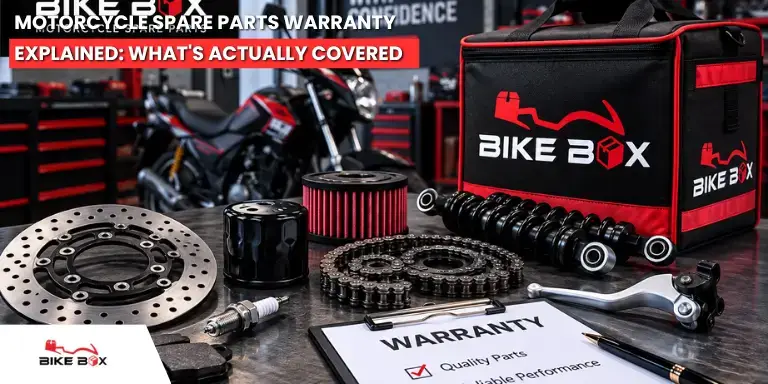
Buying motorcycle spare parts is about more than finding the right price. The quality, compatibility, installation & warranty of a part can all affect your motorcycle’s performance, reliability and long-term maintenance costs.
A warranty can provide valuable protection if a motorcycle spare part has a genuine manufacturing defect or fails under the conditions specified by the manufacturer or seller. However, a warranty does not mean that every damaged or worn-out part will automatically be repaired or replaced.
Warranty coverage depends on the part, seller, manufacturer and stated warranty terms. Installation, maintenance and how the motorcycle is used can also affect whether a claim is approved.
For motorcycle owners in Saudi Arabia (KSA), understanding these conditions before purchasing spare parts can help prevent unexpected costs and make the warranty-claim process easier.
At Bikebox, we focus on helping riders find reliable motorcycle spare parts while making purchasing decisions with greater confidence. Understanding how motorcycle warranties work can help you choose the right parts and protect your investment.
What Is a Motorcycle Spare Parts Warranty?
A motorcycle spare parts warranty is a commitment from a manufacturer or seller that a product will meet specified quality and performance standards for a defined period, subject to the applicable warranty terms and conditions.
If a part develops a qualifying defect during the warranty period, the manufacturer or seller may offer a repair, replacement or another remedy depending on its policy.
A typical warranty may cover:
- Manufacturing defects
- Defective materials or workmanship
- Certain premature failures under normal use
- Repair or replacement of an approved defective part
However, warranty coverage is not unlimited. Damage resulting from accidents, incorrect installation, unauthorized modifications, misuse or normal wear and tear may be excluded.
The warranty period generally begins according to the terms stated on the invoice, warranty document or manufacturer’s policy. Keeping your purchase records is therefore important.
What Does a Motorcycle Spare Parts Warranty Usually Cover?
The exact coverage varies between products and suppliers, but most warranties are designed to protect customers against product-related defects rather than damage caused by use or external factors.
Manufacturing Defects
A manufacturing defect is a problem that results from the production, materials or assembly of a component rather than from normal use by the rider.
Potential examples include:
- A component failing because of defective materials
- Incorrect assembly during manufacturing
- A faulty electrical connection inside a component
- A structural defect that causes premature failure
If an issue appears to be a manufacturing defect, the supplier or manufacturer may inspect the part before deciding whether the claim qualifies for warranty coverage.
Premature Failure Under Normal Use
A part that fails unusually early may qualify for warranty consideration if it has been:
- Correctly installed
- Used for its intended purpose
- Properly maintained
- Used under conditions permitted by the warranty
For example, if a motorcycle component stops functioning shortly after installation despite being correctly fitted and maintained, the supplier may inspect it to determine whether a manufacturing defect is responsible.
A short service life alone does not automatically prove a warranty defect. The cause of the failure normally needs to be established.
Repair or Replacement of Defective Parts
If a warranty claim is approved, the available remedy depends on the applicable warranty policy. Depending on the product and supplier, this could involve:
- Repairing the defective component
- Replacing the part
- Supplying an equivalent replacement
- Providing another remedy permitted under the warranty terms
Customers should check the warranty conditions before purchasing rather than assuming that every approved claim results in a brand-new replacement.
Which Motorcycle Parts May Come With a Warranty?
Warranty availability varies by manufacturer, seller and product. Different components can also have different warranty periods and exclusions.
Engine and Mechanical Components
Engine and mechanical parts can be important warranty items because a failure may affect motorcycle performance significantly.
Depending on the product, potentially covered components may include:
- Engine components
- Clutch components
- Transmission parts
- Fuel-system components
- Mechanical assemblies
Correct installation is particularly important for these parts. In some cases, service or installation records may also be useful when a claim is assessed.
Electrical and Electronic Components
Modern motorcycles rely on numerous electrical and electronic systems. Components such as sensors, ignition-related parts, control modules and other electronic equipment may have their own warranty conditions.
Potentially covered items can include:
- Sensors
- Electronic modules
- Ignition components
- Control units
- Certain wiring-related components
However, electrical failures caused by incorrect wiring, water exposure, voltage problems, unauthorized modifications or incompatible components may fall outside the warranty.
Suspension and Steering Components
Suspension and steering components have a direct effect on handling and rider safety. Depending on the product and warranty policy, coverage may apply to manufacturing defects involving:
- Fork components
- Shock absorbers
- Steering components
- Suspension assemblies
Damage caused by crashes, impacts, improper installation or extreme external forces is generally treated differently from a manufacturing defect.
Batteries and Accessories
Motorcycle batteries & accessories often have product-specific warranty conditions. Battery warranty periods can differ because battery performance is affected by factors such as:
- Charging practices
- Motorcycle electrical systems
- Storage conditions
- Temperature
- Frequency of use
- Maintenance
Accessories such as lights, mirrors, electronics and other motorcycle equipment may also have separate warranty terms. Always check the specific warranty provided with the product.
What Does a Bike Spare Parts Warranty Usually Not Cover?
Understanding exclusions is just as important as understanding coverage.
Normal Wear and Tear
Warranty policies generally distinguish manufacturing defects from components that naturally wear out through regular use.
Common examples include:
- Brake pads
- Tires
- Chains and sprockets
- Clutch plates
- Certain seals & consumable components
These items may have a limited service life and normally require replacement as part of routine motorcycle maintenance.
Accident or Impact Damage
Damage resulting from an accident or external impact is generally not considered a manufacturing defect.
Examples include:
- Collision damage
- Crash damage
- Damage caused by falling
- Impact from road hazards
- Physical damage caused by an external force
If a part is damaged in an accident, its condition does not necessarily indicate that the product itself was defective.
Incorrect Installation
Incorrect installation can cause premature failure and may affect warranty eligibility. Problems include:
- Installing the wrong part
- Incorrect fitting
- Improper torque or adjustment
- Incorrect electrical connections
- Failure to follow installation instructions
For technical components, professional installation can help reduce the risk of installation-related problems.
Unauthorized Modifications
Modifying a component or motorcycle can affect warranty coverage when the modification contributes to the failure.
Examples may include:
- Altering electrical systems
- Changing a component from its intended configuration
- Using incompatible accessories
- Performance modifications that affect related components
Whether a modification affects a particular warranty claim depends on the applicable terms and the relationship between the modification and the failure.
Poor Maintenance or Misuse
Warranty protection generally does not replace routine maintenance. Examples of misuse or maintenance-related problems include:
- Ignoring recommended servicing
- Using unsuitable fluids or lubricants
- Operating a motorcycle outside its intended conditions
- Overloading the motorcycle
- Continuing to use a visibly damaged component
Following the manufacturer’s maintenance recommendations is one of the simplest ways to protect both motorcycle performance and warranty eligibility.
How Long Does a Motorcycle Spare Parts Warranty Last?
There is no universal warranty period for every motorcycle spare part. The duration can depend on:
- Manufacturer
- Seller
- Product category
- Brand
- Country or market
- Specific warranty policy
- Type of failure covered
Some components may have longer coverage periods than others, while certain consumable products may have limited or no standard warranty coverage. Before purchasing a part, check the exact warranty period rather than relying on a general assumption about motorcycle parts.
OEM Motorcycle Parts Warranty
OEM (Original Equipment Manufacturer) parts are produced to the specifications associated with the original equipment application. Depending on the supply chain, an OEM component may be manufactured by the motorcycle manufacturer or by an approved component supplier.
Warranty arrangements for OEM parts can depend on:
- Motorcycle brand
- Component
- Authorized distribution channel
- Seller
- Market
- Applicable warranty terms
OEM does not automatically mean that every part has the same warranty period. Always verify the warranty documentation for the specific product.
Aftermarket Motorcycle Parts Warranty
Aftermarket parts are produced by manufacturers other than the original motorcycle manufacturer. Their warranty coverage can vary considerably between brands.
Before buying an aftermarket component, check:
- Warranty duration
- Covered defects
- Exclusions
- Installation requirements
- Claim procedure
- Replacement or repair conditions
- Seller or manufacturer responsibilities
A lower purchase price does not necessarily mean poorer quality, just as an aftermarket product is not automatically equivalent to an OEM component. The reputation of the manufacturer, product specifications, compatibility and warranty support all matter.
OEM vs Aftermarket Motorcycle Parts: What Should You Compare?
| Factor | OEM Parts | Aftermarket Parts |
|---|---|---|
| Compatibility | Generally designed for the intended motorcycle application | Depends on the manufacturer and specific product |
| Warranty | Depends on manufacturer, seller and product | Varies significantly by brand and seller |
| Price | Often higher | Often available at different price points |
| Availability | May depend on authorized supply channels | Often widely available |
| Quality | Generally consistent with the applicable OEM specification | Can range from basic to premium |
| Documentation | Often supplied through established distribution channels | Depends on the manufacturer and seller |
| Choice | Usually limited to approved applications | Often offers a wider range of alternatives |
| Fleet suitability | Suitable for standardized fleet operations | Depends on the solution |
The right choice depends on your motorcycle, budget, intended use, compatibility requirements and confidence in the manufacturer or buying motorcycle spare parts supplier.
Motorcycle Spare Parts Warranty in KSA: What Should Riders Check?
When buying spare parts for bikes in Saudi Arabia, don’t focus only on the warranty period. Before completing your purchase, check:
- Who provides the warranty: manufacturer or seller
- How long the coverage lasts
- Which products or defects are covered
- What exclusions apply
- Whether installation requirements apply
- What documents are required
- How warranty claims are submitted
- Whether inspection is required
- What happens if a claim is approved
- Whether shipping, labor or installation costs are covered
Warranty conditions can differ between suppliers, so comparing the actual terms is more useful than comparing warranty length alone.
How to Claim a Warranty for Bike Spare Parts
If you believe spare parts for bikes has developed a warranty-related defect, following the correct process can make the claim easier to assess.
1. Check the Warranty Terms
Start by reviewing your:
- Invoice
- Warranty card or documentation
- Product information
- Manufacturer’s warranty terms
Confirm that the product is still within its applicable warranty period.
2. Contact the Seller or Manufacturer
Contact the party identified in the warranty documentation. Be prepared to provide:
- Motorcycle make and model
- Part name or part number
- Purchase date
- Invoice details
- Description of the problem
- Installation information
3. Provide Evidence
Clear evidence can help the supplier understand the problem. Depending on the claim, useful information may include:
- Photos of the component
- Videos showing the problem
- Installation records
- Service records
- Technical inspection reports
- Diagnostic information
4. Allow the Part to Be Inspected
A supplier or manufacturer may need to inspect the component before determining whether the failure qualifies for warranty coverage.
The inspection may help distinguish between:
- Manufacturing defects
- Normal wear
- Incorrect installation
- Misuse
- Accident damage
- External causes
5. Follow the Approved Resolution
If the claim is approved, the supplier will provide the remedy available under its warranty policy. This could be a repair, replacement or another applicable solution.
Do not dispose of the defective part before the supplier has completed the claim process unless you have been instructed to do so.
Documents You Should Keep for a Warranty Claim
Good documentation can make the warranty process easier.
Purchase Invoice
Your invoice can help establish:
- Where the product was purchased
- When it was purchased
- Which product was purchased
- Applicable transaction information
Keep your invoice in a safe place after purchasing motorcycle parts.
Warranty Documentation
If a warranty card or product warranty document is provided, keep it with your purchase records. It may contain important information about:
- Coverage period
- Exclusions
- Claim procedure
- Warranty conditions
Installation and Service Records
For certain components, installation and maintenance records can help demonstrate that the part was fitted and maintained correctly.
Useful records may include:
- Installation receipts
- Workshop invoices
- Service history
- Maintenance records
How to Avoid Spare Parts for Bikes Warranty Problems
The best warranty claim is often the one you never need to make.
Buy From a Reliable Supplier
Purchase from a supplier that provides clear product information, appropriate documentation, and transparent warranty terms. A reliable supplier can also reduce the risk of receiving counterfeit, incompatible or incorrectly specified parts.
Check Compatibility Before Buying
A warranty does not necessarily protect against buying the wrong part. Before ordering, verify:
- Motorcycle make
- Model
- Model year
- Engine or variant information
- Part number
- Compatibility information
When in doubt, confirm compatibility with the seller or manufacturer before installation.
Follow Installation Instructions
Incorrect installation can cause failures that are unrelated to manufacturing quality. For complex components, use a qualified technician and follow the manufacturer’s installation instructions.
Keep Your Records
Store your invoice, warranty documentation, installation records and service history. Good records can save time if you need to make a claim later.
Understand the Warranty Before Paying
Before purchasing spare parts, know:
- Warranty duration
- What is covered
- What is excluded
- Who handles the claim
- What documents are required
- Whether inspection is required
- What remedy is available if the claim is approved
Taking a few minutes to check these details can prevent confusion later.
Why Warranty Matters When Buying Motorcycle Spare Parts
A warranty is more than a marketing feature. It can be an important indicator of how a manufacturer or supplier supports its products. However, warranty length should not be the only factor you consider.
A better purchasing decision considers:
Compatibility + Product Quality + Supplier Reputation + Warranty Terms + Price
A cheaper component with unclear specifications or limited support may not provide the best long-term value. Likewise, a more expensive part is not automatically the right choice.
The goal is to choose a component that is suitable for your motorcycle and supported by clear, understandable terms.
Final Thoughts
Spare parts for bikes warranty can provide valuable protection against qualifying manufacturing defects and product failures, but it does not cover every type of damage.
Manufacturing defects and certain premature failures may be covered, while normal wear and tear, accidents, incorrect installation, unauthorized modifications, misuse and maintenance-related problems may be excluded depending on the applicable terms.
Whether you choose OEM or aftermarket motorcycle parts, always check the specific warranty conditions before purchasing. Pay attention to the coverage period, exclusions, installation requirements, claim process, and documentation requirements.
For riders in Saudi Arabia, choosing a dependable supplier and understanding the applicable warranty terms can make the purchasing experience much easier.
At Bikebox, we aim to help motorcycle riders find quality spare parts while making informed purchasing decisions. By checking compatibility, product quality and warranty conditions before buying, you can make a more confident choice and protect your motorcycle investment.
FAQs
Do all bike spare parts come with a warranty?
No. Warranty availability depends on the manufacturer, seller, product type and applicable warranty policy. Always check the warranty terms for the specific part before purchasing.
Can I claim a motorcycle parts warranty without an invoice?
An invoice is commonly used to verify the purchase date and seller, but requirements vary between suppliers. If you have lost your invoice, contact the seller and ask whether alternative proof of purchase is accepted.
Are used bike parts covered by warranty?
Used parts do not automatically have the same warranty protection as new products. Some sellers may offer limited warranty coverage on used components, but this depends entirely on the seller’s stated terms.
Does installing aftermarket parts affect warranty coverage?
Installing an aftermarket part does not automatically mean that every warranty is invalid. However, coverage can be affected if the aftermarket component, its installation, or a related modification causes the failure or violates the applicable warranty conditions.
Are motorcycle batteries covered by warranty?
Many motorcycle batteries are sold with a limited warranty, but coverage and duration vary by manufacturer and seller. Battery warranties can also have specific conditions related to charging, storage, usage, and electrical-system problems.
Does warranty cover installation costs?
Not necessarily. Whether labor, installation, removal, inspection, shipping or other related costs are covered depends on the specific warranty terms. Check these conditions before purchasing.
What should I do if my motorcycle part fails during the warranty period?
Stop using the component if continued use could create a safety risk, then contact the seller or manufacturer according to the warranty procedure. Keep the defective part and provide the requested purchase information, photos, videos and service or installation records.