Ever wondered why some motorcycles start with one button press while others need a choke and a few attempts? The difference often comes down to the fuel delivery system.
Motorcycles use two main technologies to supply fuel: carburetors and electronic fuel injection (EFI). Both help engines run, but their components, maintenance requirements and repair methods differ.
Understanding carburetor vs fuel injection on motorcycles helps you identify problems, avoid unnecessary repairs and select the right replacement parts.
Whether you are maintaining an older motorcycle or commuting through Dubai or Abu Dhabi, this guide explains what matters for everyday ownership.
What Is the Difference Between a Carburetor and Fuel Injection on a Motorcycle?
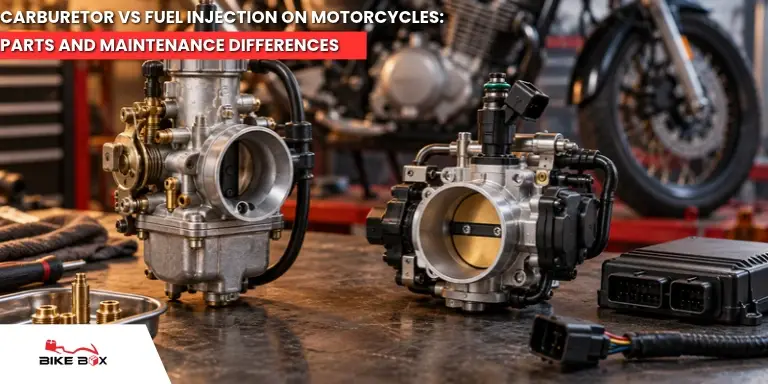
A carburetor mechanically mixes air and fuel using airflow and pressure differences. Electronic fuel injection (EFI) uses sensors, an ECU and fuel injectors to control fuel delivery.
Here is how they compare:
| Feature | Carburetor | Fuel Injection |
|---|---|---|
| Fuel delivery | Mechanical | Electronically controlled |
| Main parts | Jets, float bowl, needles | Injectors, ECU, sensors |
| Cold starting | May need choke | Usually automatic |
| Fuel efficiency | Depends on tuning | Generally more precise |
| Maintenance | More cleaning and adjustments | Fewer routine adjustments |
| Diagnosis | Mostly mechanical | May require diagnostic tools |
| Repair costs | Often lower for simple jobs | Electronic repairs can cost more |
| Altitude changes | May need adjustment | Usually compensates automatically |
The main takeaway? Carburetors offer mechanical simplicity, while EFI provides more precise fuel control.
Motorcycle Carburetor vs Fuel Injection: Key Parts Compared
Both systems deliver fuel, but their internal components work differently.
Main Parts of a Motorcycle Carburetor
A motorcycle carburetor uses mechanical components to regulate fuel delivery.
Its main parts include:
- Float bowl: Holds fuel before delivery.
- Main jet: Controls fuel flow at larger throttle openings.
- Pilot jet: Supplies fuel during idling and low-speed operation.
- Float needle: Helps maintain the correct fuel level.
- Throttle slide or butterfly: Regulates airflow.
- Choke or enricher: Supports cold starting.
For example, a blocked pilot jet can cause unstable idling, even when the motorcycle runs normally at higher speeds. These small components make carburetor cleanliness important.
Main Parts of a Motorcycle Fuel Injection System
A motorcycle fuel injection system relies on electronic controls and pressurized fuel.
Important components include:
- Fuel injector: Sprays a measured amount of fuel.
- Fuel pump: Delivers fuel at the required pressure.
- ECU: Processes sensor information and controls injection.
- Throttle body: Regulates incoming air.
- Engine sensors: Monitor operating conditions.
- Fuel pressure regulator: Maintains suitable pressure where fitted.
For example, the ECU can adjust fueling when the engine is cold or the rider accelerates. The exact components and their locations vary by motorcycle model.
Which System Has Simpler Parts to Repair or Replace?
Carburetors are generally easier to dismantle and repair using basic mechanical tools. EFI components may require electrical testing and specialized diagnostic equipment.
However, simpler construction does not guarantee cheaper repairs. Replacement parts for rare carburetors can be difficult to find.
For reliable maintenance, selecting compatible motorcycle spare parts matters. At Bikebox, riders can explore high-quality motorcycle spare parts in the UAE. Check your motorcycle’s model, year, and part specifications before ordering.
Carburetor vs Fuel Injection Maintenance: What’s Different?
The biggest carburetor vs fuel injection maintenance difference involves cleaning, adjustments and troubleshooting.
Carburetor Cleaning and Routine Maintenance
Carburetors contain narrow fuel passages that can become blocked by dirt or old petrol deposits. Important maintenance tasks include:
- Cleaning jets and fuel passages.
- Inspecting float needles and seals.
- Checking fuel hoses for leakage.
- Inspecting the air filter.
- Adjusting idle settings when necessary.
Motorcycle carburetor cleaning is particularly important after prolonged storage. Avoid pushing hard metal objects through jets. Doing so can enlarge openings and affect fuel metering.
Fuel Injection System Maintenance Requirements
EFI systems require fewer routine adjustments, but several components still need attention. Check fuel lines, electrical connectors and serviceable fuel filters according to the maintenance schedule.
Motorcycle fuel injector cleaning should generally be performed when testing indicates contamination or restricted flow.
A poorly running motorcycle does not automatically need new injectors. Faulty spark plugs, weak batteries or air leaks can produce similar symptoms.
Tuning, Adjustments and Synchronization
Carburetors may need idle adjustments, jet changes or synchronization on multi-carburetor motorcycles.
EFI relies primarily on ECU programming and sensor information. Some multi-cylinder fuel-injected motorcycles also need throttle-body synchronization.
Avoid changing factory settings without appropriate instructions. Incorrect tuning can increase fuel consumption and cause poor engine operation.
Maintenance After Long-Term Bike Storage
Unused motorcycles can develop fuel-related problems. Petrol can deteriorate and form sticky deposits, particularly inside carburetor float bowls.
Before extended storage:
- Follow the manufacturer’s fuel storage instructions.
- Use suitable fuel stabilizer when recommended.
- Drain carburetor bowls if specified.
- Maintain battery charge.
- Choose a shaded, ventilated storage location.
During UAE summer months, protecting motorcycles from prolonged direct sunlight and excessive heat is especially worthwhile.
Which System Requires More Frequent Maintenance?
Carburetors generally need more frequent hands-on attention because their mechanical fuel passages and settings can become affected by deposits or wear.
EFI usually reduces routine adjustment work. However, both systems need proper fuel, regular inspections, and maintenance according to the manufacturer’s schedule.
Common Carburetor and Fuel Injection Problems on Motorcycles
Fuel-system faults can cause starting difficulties, weak acceleration and uneven engine operation. Recognizing symptoms helps you decide what to inspect first.
Common Carburetor Problems and Symptoms
Typical motorcycle carburetor problems include:
- Blocked jets: Hesitation or poor idling.
- Sticking float needle: Fuel overflow.
- Damaged seals: Fuel leakage.
- Incorrect adjustment: Unstable idle or poor response.
If your motorcycle runs only with the choke engaged, a restricted fuel passage or unwanted air entering the intake may be responsible.
Common Fuel Injection Problems and Symptoms
Common motorcycle EFI problems include:
- Dirty injectors causing uneven fuel delivery.
- Weak fuel pumps reducing fuel pressure.
- Faulty sensors affecting fueling.
- Wiring damage causing intermittent operation.
Some motorcycles display an engine warning light when a fault is detected. However, diagnostic codes identify possible problem areas, not necessarily defective replacement parts.
How to Diagnose Motorcycle Fuel System Problems
Start with basic checks before spending money on components.
| Symptom | Possible cause | Recommended first check |
|---|---|---|
| Difficult starting | Weak battery, fuel delivery issue | Battery and fuel supply |
| Rough idle | Dirty jet, intake leak, sensor issue | Air filter and intake connections |
| Poor acceleration | Restricted fuel flow | Fuel supply and filter condition |
| Fuel smell or leakage | Damaged hose, seal, or float valve | Visible fuel-system connections |
| Engine warning light | Electronic or sensor fault | Read diagnostic trouble codes |
Important: These symptoms are not proof of a specific fault. Never open pressurized EFI fuel lines without the correct depressurization procedure. Stop riding immediately if fuel is leaking.
Carburetor vs Fuel Injection: Maintenance and Repair Costs
Bike fuel system repair costs vary depending on the model, replacement components, labour and workshop.
Carburetor Cleaning, Rebuilding and Replacement Costs
Carburetor cleaning is often relatively affordable because technicians can service individual parts.
Common expenses include cleaning materials, gaskets, jets and labour. A complete rebuild costs more when multiple internal components need replacement. Older motorcycles may also require hard-to-find parts, increasing costs.
Fuel Injector, Fuel Pump and Sensor Repair Costs
EFI repair expenses depend on the failed component. Professional injector cleaning may cost considerably less than replacing a fuel pump or ECU.
Electrical diagnosis can also increase labour costs. Before replacing expensive components, ask your mechanic to confirm the problem through appropriate testing.
Which Fuel System Is Cheaper to Maintain Long-Term?
Carburetors often have lower costs for basic mechanical repairs. EFI can reduce spending on repeated cleaning and adjustments. However, one expensive electronic failure may change the overall comparison.
Rather than choosing solely on repair prices, consider motorcycle condition, parts availability and maintenance history.
For replacement components, Bikebox provides premium motorcycle spare parts in the UAE. Choosing the correct parts helps support reliable repairs and prevents compatibility-related problems.
Carburetor vs Fuel Injection: Performance, Fuel Efficiency and Reliability
Fuel delivery also influences how a motorcycle performs under changing riding conditions.
Cold Starting and Throttle Response
Carbureted motorcycles may require choke adjustment during cold starts. EFI automatically adjusts fuel delivery based on available sensor information. A properly calibrated EFI system generally provides consistent starts and smooth acceleration.
However, a well-maintained carburetor can also deliver excellent throttle response.
Fuel Efficiency and Emissions
When comparing carburetor vs fuel injection fuel efficiency, EFI generally has an advantage. Its precise fuel control can improve combustion efficiency and reduce emissions.
However, actual mileage depends on engine design, traffic, riding style and maintenance. A poorly maintained EFI motorcycle may consume more fuel than a properly tuned carbureted bike.
Performance in Different Temperatures and Altitudes
Air density changes with temperature and altitude. Carburetors may require adjustments when operating conditions change significantly.
EFI systems usually compensate automatically using sensor data, although their capabilities differ. This makes fuel injection particularly convenient for riders travelling through varied environments.
Long-Term Reliability and Parts Availability
Both systems can remain reliable for many years with suitable maintenance. Carburetors are mechanically accessible, although seals, diaphragms and needles eventually wear. EFI systems offer consistent fuel control, but pumps and electronic components can fail.
Access to compatible motorcycle replacement parts is therefore an important ownership consideration.
Carburetor vs Fuel Injection: Pros and Cons for Motorcycle Owners
Neither system is automatically better in every situation.
Advantages and Disadvantages of Carbureted Motorcycles
Advantages:
- Straightforward mechanical construction.
- Easier DIY servicing.
- Often affordable basic repairs.
Disadvantages:
- More cleaning and adjustment.
- Possible cold-start difficulties.
- Limited automatic adaptation to changing conditions.
Carburetors appeal to riders who enjoy traditional bike maintenance.
Advantages and Disadvantages of Fuel-Injected Motorcycles
Advantages:
- Precise fuel delivery.
- Consistent starting.
- Fewer routine adjustments.
- Better adaptation to environmental changes.
Disadvantages:
- More complex electrical troubleshooting.
- Potentially expensive electronic replacements.
- Possible need for specialist diagnostic tools.
EFI generally suits riders who prioritize daily convenience.
Which Is Better: Carburetor or Fuel Injection for Your Motorcycle?
The right choice depends on how you use and maintain your motorcycle.
Best for Riders Who Prefer DIY Maintenance
Carburetors are often appealing to mechanically experienced riders. Their basic design allows many cleaning and adjustment tasks to be completed with common workshop tools.
Best for Daily Commuting and Low-Maintenance Ownership
Fuel injection is generally more convenient for everyday commuting. Automatic fueling adjustments and consistent starting reduce the need for regular mechanical tuning. For riders navigating busy Dubai or Abu Dhabi traffic, this convenience can be valuable.
Best for Older Motorcycles and Budget Repairs
A carbureted motorcycle can be economical when replacement components are readily available. However, overall condition matters more than fuel-system type. A well-maintained EFI motorcycle may be cheaper to own than a poorly maintained carbureted one.
Final Thoughts
Understanding carburetor vs fuel injection on motorcycles makes maintenance decisions easier.
Carburetors offer mechanical simplicity and accessible repairs. EFI provides precise fueling, consistent starting and fewer routine adjustments.
Both systems need appropriate maintenance and compatible replacement components.
Whether you own a classic carbureted motorcycle or a modern EFI bike, Bikebox helps riders in the UAE find reliable motorcycle spare parts for their maintenance needs.
Looking for the right replacement parts for your motorcycle? Contact Bikebox to find compatible motorcycle spare parts in the UAE. Share your motorcycle’s make, model, year and required part to help identify a suitable replacement.
FAQs
Does a Fuel-Injected Motorcycle Need Less Maintenance Than a Carbureted Bike?
Yes. Fuel-injected motorcycles generally require fewer routine fuel-system adjustments. However, injectors, fuel pumps, sensors and electrical connections still need attention when problems develop.
Is a Carburetor Cheaper to Repair Than Fuel Injection?
Carburetors are often cheaper to repair because cleaning and rebuilding require simpler tools. EFI repairs can cost more when electronic components or specialized testing are necessary.
Can I Clean a Motorcycle Fuel Injector Myself?
Some fuel-system cleaners are suitable for home use when approved by the manufacturer. Severe injector blockages may require professional cleaning and flow testing.
How Do I Know If My Motorcycle Has a Carburetor or Fuel Injection?
Check your owner’s manual or manufacturer specifications. Carbureted motorcycles use mechanical carburetors, while EFI motorcycles use electronically controlled injectors and an ECU.
Which Is More Reliable for Long-Distance Riding?
Fuel injection generally offers greater convenience during long-distance travel because it adjusts to changing operating conditions. However, a properly maintained carbureted motorcycle can also be reliable.